
Technical Pattern Recognition - Tom Demark's Sequential Indicator Part I
Advanced Pattern Recognition and Technical Analysis


Technical analysis is full of tools that try to answer the same basic question: is the current trend likely to continue, or is it getting tired?
Tom DeMark’s Sequential Indicator is one of the more popular tools designed to identify possible exhaustion points in price movement. Traders often use it to spot areas where a bullish or bearish move may be stretched and where a pause, pullback, or reversal could become more likely.
This first part focuses only on the TD Setup, commonly called TD 9.
TD 9 is not meant to predict the future with certainty. Instead, it gives traders a structured way to recognize when price has moved in one direction for a sustained period. The key idea is simple: when the market keeps closing higher or lower compared with earlier candles, momentum may be reaching an exhaustion point.
What Is the TD Setup?
The TD Setup is a counting pattern based on candle closes.
A bullish TD Setup occurs after a series of lower closes. It can suggest that selling pressure may be weakening.
A bearish TD Setup occurs after a series of higher closes. It can suggest that buying pressure may be weakening.
The count runs from 1 to 9. When the count reaches 9, traders often pay closer attention because the move may be mature.
The TD Setup compares each candle’s close with the close four candles earlier.
That four-candle comparison is the core rule.
Bearish TD Setup
A bearish TD Setup forms when price records nine consecutive closes, where each close is higher than the close four candles earlier.
In simple terms:
Current close > close four candles ago
This condition must happen nine times in a row.
For example, if today’s candle closes higher than the candle from four periods ago, that may start or continue the bearish setup count. If the condition keeps holding, the count advances until it reaches 9.
Despite the name “bearish setup,” price is usually rising while this pattern forms. The bearish label comes from the idea that the upward move may be getting stretched.
A completed bearish TD 9 does not automatically mean price must fall. It means the trend may be vulnerable to hesitation, consolidation, or reversal.
Bullish TD Setup
A bullish TD Setup forms when price records nine consecutive closes, where each close is lower than the close four candles earlier.
In simple terms:
Current close < close four candles ago
Again, this condition must happen nine times in a row.
A bullish TD Setup usually appears during a decline. The count increases as price continues to close below the level from four candles earlier. When the count reaches 9, traders may begin watching for signs that selling pressure is becoming exhausted.
The word “bullish” does not mean price will immediately rise. It means the downside move may be overextended and worth monitoring for a possible reaction.
I built Quant Atlas to cut through market noise.
No opinions. Just quantitative, robust, quality forecasts.
Try it yourself in real time.
How the TD 9 Count Works
The TD Setup begins when the current candle closes above or below the close from four candles earlier.
For a bearish setup, each close must be higher than the close four candles earlier.
For a bullish setup, each close must be lower than the close four candles earlier.
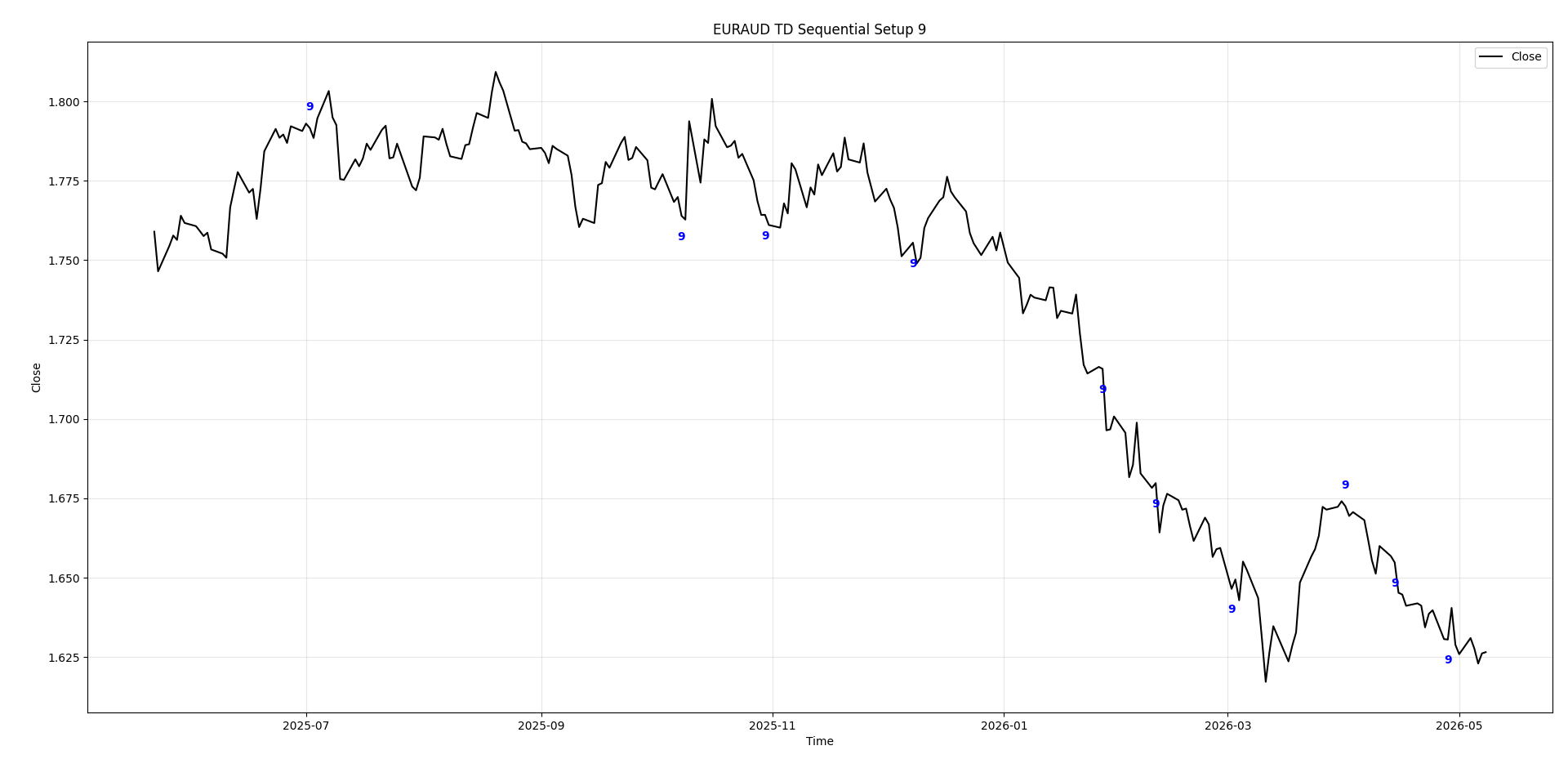
Once the first valid candle appears, it is labeled 1. The next candle is checked using the same four-candle comparison. If it also qualifies, it becomes 2. This continues until the count reaches 9.
If any candle fails the condition before the setup completes, the count is interrupted.
For example, in a bearish setup, if candle number 6 does not close higher than the close four candles earlier, the sequence is broken. The trader would no longer treat that as a valid completed TD 9 setup.
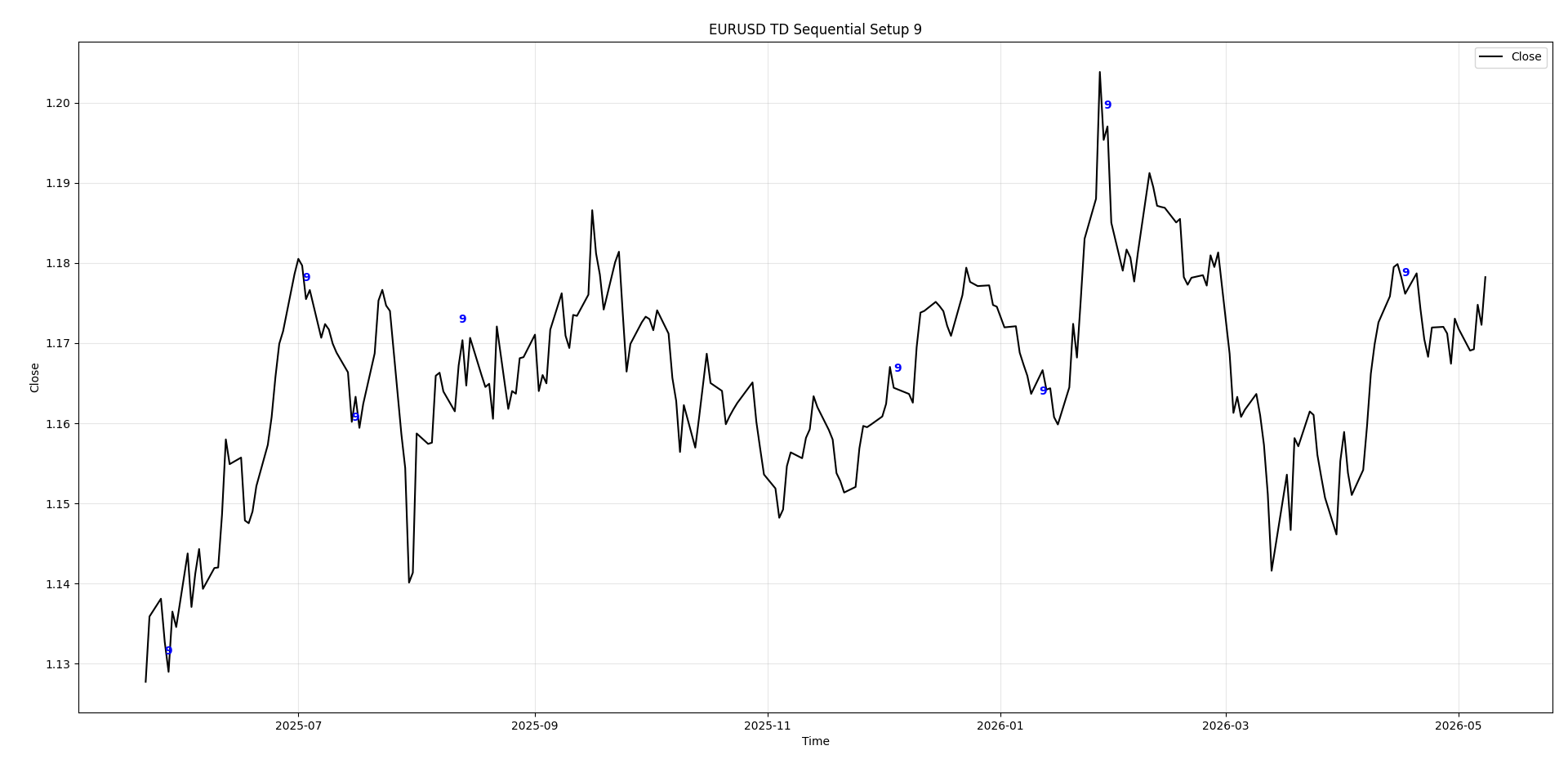
When the number appears below the close price, it’s a bullish pattern and when it appears above the close price, it’s a bearish pattern.
Why Traders Watch the Number 9
The number 9 matters because it signals that the market has produced a consistent directional move across multiple candles.
In an uptrend, nine qualifying closes suggest buyers have been in control for a while. That can be a sign of strength, but it can also mean the move is becoming crowded or tired.
In a downtrend, nine qualifying closes suggest sellers have been in control for a while. The decline may continue, but the risk of a bounce can increase.
This is why many traders use TD 9 as an exhaustion signal rather than a direct buy or sell command. A TD 9 should be treated as a warning light, not a trading system by itself.
When a bearish TD 9 appears, traders may look for:
Loss of upside momentum
Rejection near resistance
Smaller candle bodies
Long upper wicks
A break below a short-term support level
When a bullish TD 9 appears, traders may look for:
Selling pressure slowing down
Rejection near support
Smaller downside candles
Long lower wicks
A break above a short-term resistance level
The TD 9 signal is often stronger when it appears near an important price area. For example, a bearish TD 9 near major resistance may carry more weight than one appearing in the middle of a range. A bullish TD 9 near major support may be more meaningful than one forming in a weak, undefined area.
TD 9 Is Not a Standalone Signal
One common mistake is treating every TD 9 as an automatic reversal signal.
Markets can stay strong after a bearish TD 9. They can also continue falling after a bullish TD 9. Strong trends often ignore exhaustion signals, especially when there is heavy volume, major news, or broad market momentum behind the move.
The signal becomes more useful when it lines up with other evidence.
A Simple Example
Imagine a stock has been rising for several sessions. Each new close is higher than the close four candles earlier. The TD count begins at 1 and keeps increasing as long as the rule remains valid.
By the time the count reaches 9, the stock may look strong, but the setup suggests the move is extended. A trader might avoid opening a fresh long position at that point. Another trader might tighten a stop, take partial profit, or watch for confirmation of weakness.
The same logic applies in reverse for a falling market. If price keeps closing below the close from four candles earlier and the count reaches 9, traders may begin watching for a possible bounce or slowing downside momentum.
Like any technical indicator, TD 9 works best when combined with context, confirmation, and disciplined risk management.