
Sequential Pattern Averaging Regressor - Presenting my New Model
A Layman's Terms Introduction to SPAR

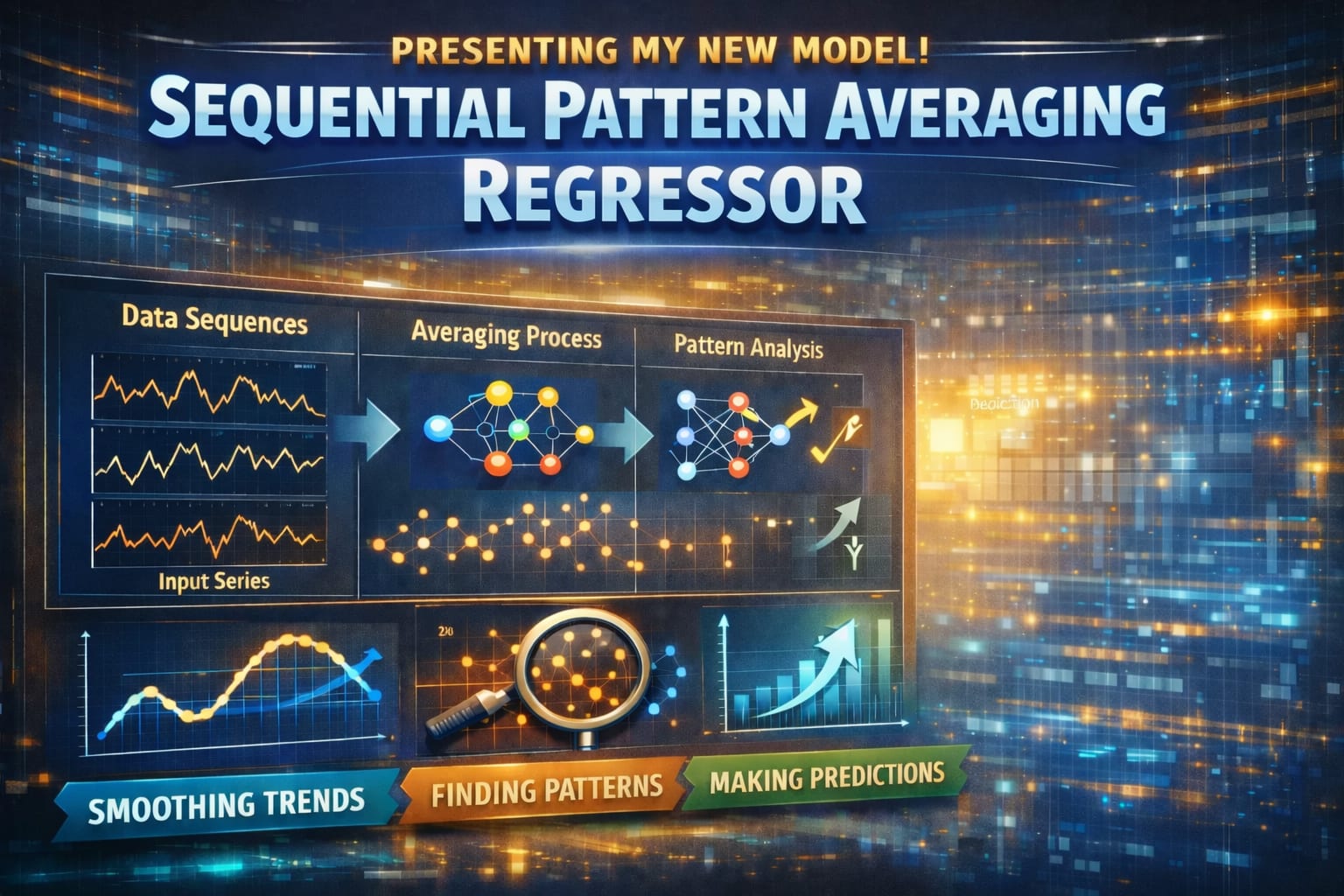
Most people think market prediction requires either complex mathematics or powerful artificial intelligence models trained on massive datasets.
Neural networks. Deep learning. Black boxes. But what if forecasting prices could be done in a far simpler, more transparent way?
What if, instead of teaching a model to learn abstract relationships, we simply asked a very human question:
“When the market behaved like this before, what usually happened next?”
That single idea is the foundation of SPAR — the Sequential Pattern Averaging Regressor.
This article explains what SPAR does, how it works, and why it represents a fundamentally different way of thinking about prediction.
No math required.
The Core Idea: Markets Repeat Sometimes
Markets are noisy, chaotic, and often unpredictable.
But they are not random.
Certain sequences of behavior show up again and again:
several days up in a row
sharp reversals
choppy back-and-forth movement
steady trends
Traders have noticed this for decades. That’s where chart patterns and candlestick analysis come from.
The problem is that traditional technical analysis is:
subjective
hard to test
difficult to quantify
SPAR takes that intuition and turns it into a systematic, rules-based model.
Instead of eyeballing charts, SPAR:
Breaks price movement into simple directions
Records what happened next every time a pattern appeared
Uses history as a lookup table for future forecasts
No training in the usual machine-learning sense.
No parameter tuning.
No hidden logic.
Just memory, aggregation, and statistics.
Step 1: Forget the Size of Price Moves
Most models care about how much prices move.
SPAR does not.
Instead, it only cares about direction:
Did price go up?
Did it go down?
Or did it stay more or less flat?
That’s it.
A small up move and a large up move are treated the same.
Why does this matter?
Because it makes the model:
robust across different assets
insensitive to volatility regimes
usable on stocks, currencies, commodities, or crypto
SPAR focuses on structure, not magnitude.
Step 2: Turn the Market into Simple Sequences
Once prices are converted into directions, SPAR looks at short sequences, for example:
Up → Up → Down → Up → Up
Down → Down → Flat → Up → Down
Each sequence becomes a pattern.
Think of it like words made from a very small alphabet.
The model also adds one more piece of information:
Was the overall move positive or negative during that sequence?
This helps distinguish patterns that look similar but occur in different contexts.
Step 3: Build a Memory of What Happened Next
Now comes the key part.
Every time a specific pattern appears in historical data, SPAR records:
what prices did after that pattern
over the next few days
Over time, this creates a database that looks like:
“When this exact pattern occurred before, here are all the outcomes that followed.”
Some patterns appear dozens of times.
Some appear hundreds.
Some barely appear at all.
SPAR doesn’t guess.
It counts.
Stop Guessing. Start Trading with The Signal Beyond report 🚀
COT Data • Technical charts • Equity Arbitrage • Seasonality
Step 4: Majority Rules (Literally)
When a pattern appears again in live data, SPAR asks:
“Historically, did this pattern usually lead to higher prices or lower prices?”
If most past outcomes were positive:
SPAR issues a bullish signal
If most were negative:
